Tony Fluxa

Artefactos, FinTech, Financial Reports y Blog

📊 Financial Reports

📊

Injection of liquidity into the system


## ✅ **FACT‑CHECK SUMMARY (PRIOR TO THE REPORT)**

### ✔️ **Confirmed / Substantially Accurate**
- **$200 billion mortgage bond purchases**  
  President **Donald Trump publicly announced (Jan 8, 2026)** that he instructed the use of **Fannie Mae and Freddie Mac liquidity** to purchase **$200B in mortgage‑backed securities**.  
  This is confirmed by **Reuters** and **AP News**. ([reuters.com](https://www.reuters.com/world/us/trump-orders-his-representatives-buy-200-billion-dollars-mortgage-bonds-2026-01-08/?utm_source=openai))

- **Mechanism resembles quasi‑QE**  
  The operation is widely compared by analysts to **non‑Fed balance‑sheet expansion**, although outside the Federal Reserve framework. ([reuters.com](https://www.reuters.com/world/us/trump-orders-his-representatives-buy-200-billion-dollars-mortgage-bonds-2026-01-08/?utm_source=openai))

- **Supreme Court risk on Trump tariffs is real and imminent**  
  The **US Supreme Court** is expected to rule on the legality of **IEEPA‑based tariffs**, with potential refunds of up to **$150B**. ([reuters.com](https://www.reuters.com/business/autos-transportation/countries-industries-most-exposed-trumps-ieepa-based-tariffs-2026-01-08/?utm_source=openai))

- **US oil investment rhetoric regarding Venezuela exists**  
  Trump has publicly stated that US oil companies should invest **“billions”** in Venezuelan infrastructure, though **no binding commitments exist**. ([theguardian.com](https://www.theguardian.com/us-news/2026/jan/03/us-oil-trump-venezuela?utm_source=openai))

---

### ⚠️ **Not Supported by Consensus Data**
- **US economic growth above 4%**  
  This claim is **not supported** by OECD, Goldman Sachs, Morgan Stanley, UN, PIIE, or the Philadelphia Fed.  
  **Consensus 2026 US GDP growth:** **~1.6%–2.6%**, depending on scenario. ([reuters.com](https://www.reuters.com/business/un-predicts-world-economic-growth-slip-27-2026-2026-01-08/?utm_source=openai))

➡️ Therefore, the **>4% growth figure should be treated as a bullish analytical estimate, not a macro fact**.

---

---

# 📊 **INVESTOR BRIEF**
## Liquidity Expansion, Policy Risk, and Asset Market Implications (January 2026)

---

### ### **Executive Summary**

The Trump administration has initiated a **$200 billion liquidity operation** through Fannie Mae and Freddie Mac, aimed at purchasing mortgage‑backed securities using existing agency balance‑sheet resources. This action represents a **meaningful, near‑term increase in system liquidity**, with potential implications for **equities, gold, and digital assets**, including Bitcoin.

While the **macroeconomic backdrop remains resilient**, consensus forecasts do **not support claims of >4% US growth**. Instead, markets are likely being driven by **liquidity dynamics, policy expectations, and risk appetite**, rather than pure real‑economy acceleration.

---

### ### **1. Liquidity Injection: Structure and Market Impact**

**Policy Action**
- $200B in mortgage‑backed securities purchases.
- Executed via **Fannie Mae and Freddie Mac**, both under federal conservatorship.
- Funded through existing liquidity, including Treasury bill sales.

**Market Interpretation**
- Liquidity previously parked in low‑velocity government instruments is re‑introduced into the financial system.
- The operation functions as a **quasi‑quantitative easing mechanism**, though without Federal Reserve involvement.

**Expected Asset Impact**
- ✅ Positive for equities
- ✅ Supportive for gold
- ✅ Structurally favorable for Bitcoin and cryptoassets

([reuters.com](https://www.reuters.com/world/us/trump-orders-his-representatives-buy-200-billion-dollars-mortgage-bonds-2026-01-08/?utm_source=openai))

---

### ### **2. US Economic Growth: Reality vs Narrative**

**Consensus View**
- 2026 US GDP growth expected between **1.6% and 2.6%**.
- Growth supported by:
  - AI‑related capital investment
  - Fiscal easing
  - Gradual monetary accommodation

**Key Risk**
- Tariffs, immigration constraints, and policy uncertainty cap upside growth potential.

**Investor Takeaway**
> Markets are currently more sensitive to **liquidity flows** than to incremental changes in GDP growth.

([reuters.com](https://www.reuters.com/business/un-predicts-world-economic-growth-slip-27-2026-2026-01-08/?utm_source=openai))

---

### ### **3. Legal Risk: Supreme Court and Tariffs**

**Event Risk**
- Supreme Court ruling on Trump’s IEEPA‑based tariffs.
- Potential forced refunds estimated at **~$150B**.

**Market Implications**
- Short‑term volatility possible.
- Medium‑term outcome likely **liquidity‑positive** if refunds are mandated or tariffs are reduced.

**Asset Sensitivity**
- Equities: short‑term noise, medium‑term relief
- Cryptoassets: likely benefit from increased dollar liquidity

([reuters.com](https://www.reuters.com/business/autos-transportation/countries-industries-most-exposed-trumps-ieepa-based-tariffs-2026-01-08/?utm_source=openai))

---

### ### **4. Bitcoin: Market Structure and Macro Context**

**Technical Observations**
- Bitcoin continues to respect key moving averages.
- Market structure consistent with **consolidation rather than distribution**.

**Macro Overlay**
- Liquidity expansion historically correlates with improved crypto performance.
- Bitcoin increasingly trades as a **liquidity‑sensitive macro asset**.

**Investor View**
- No evidence of structural weakness at present.
- Breakout potential dependent on sustained liquidity flows.

---

### ### **5. Venezuela and Medium‑Term Liquidity Risk**

**Policy Narrative**
- Trump administration rhetoric suggests large‑scale US energy investment in Venezuela.

**Reality Check**
- No binding commitments.
- Any meaningful capital deployment would:
  - Be gradual
  - Likely occur **late 2026 or beyond**
  - Represent a **liquidity drain**, not an immediate shock

**Conclusion**
- **Not a short‑term market risk**, but relevant for medium‑term liquidity monitoring.

([theguardian.com](https://www.theguardian.com/us-news/2026/jan/03/us-oil-trump-venezuela?utm_source=openai))

---

### ### **6. Strategic Investor Conclusion**

- **Short term (weeks–months):**  
  Liquidity expansion dominates → constructive for risk assets.

- **Medium term (late 2026):**  
  Watch for:
  - Liquidity reversals
  - Fiscal sustainability
  - Energy‑related capital absorption

> The current environment favors **tactical risk exposure**, not complacency.

---

---

## ⚠️ **DISCLAIMER**

This report is provided **for informational and educational purposes only** and does **not constitute investment advice, financial advice, trading advice, or a recommendation** to buy or sell any asset or security.

All views expressed are based on publicly available information as of **January 9, 2026**, and are subject to change without notice. Past performance is not indicative of future results. Investing in financial markets, including cryptocurrencies, involves risk, including the potential loss of capital.

Readers should conduct their own independent research and consult with a licensed financial advisor before making any investment decisions.

Tony FluxĂĄ 01/09/2026

Gratis
📊

PolĂ­ticas de Liquidez de Trump para Main Street y Oportunidades en el Sector EnergĂŠtico USA

OPORTUNIDAD EN EL SECTOR ENERGÉTICO USA

La Convergencia de IA, PolĂ­ticas Trump y ModernizaciĂłn de Red

┌─────────────────────────────────────────────────────────────┐
│                                                                                                                                                                                                                           â”‚
│   đŸ¤– EXPLOSIÓN DE DEMANDA ENERGÉTICA POR IA                                                                                                                                │
│                                                                                                                                                                                                                           â”‚
│   â€˘ ChatGPT consume 10x mĂĄs energĂ­a que una bĂşsqueda Google                                                                                                                │
│   â€˘ Un solo data center = consumo de 50,000 hogares                                                                                                                                     â”‚
│   â€˘ Entrenamiento GPT-4 = electricidad de 1,000 casas/aĂąo                                                                                                                            │
│                                                                                                                                                                                                                           â”‚
└─────────────────────────────────────────────────────────────┘
  

📈 LA OPORTUNIDAD EN NÚMEROS

MĂŠtrica Hoy 2030 Crecimiento
Consumo Data Centers 4.5% red USA 10%+ red USA +122%
Electricidad necesaria 176 TWh 450+ TWh +156%
Nueva capacidad - +80 GW Masivo
Gratis
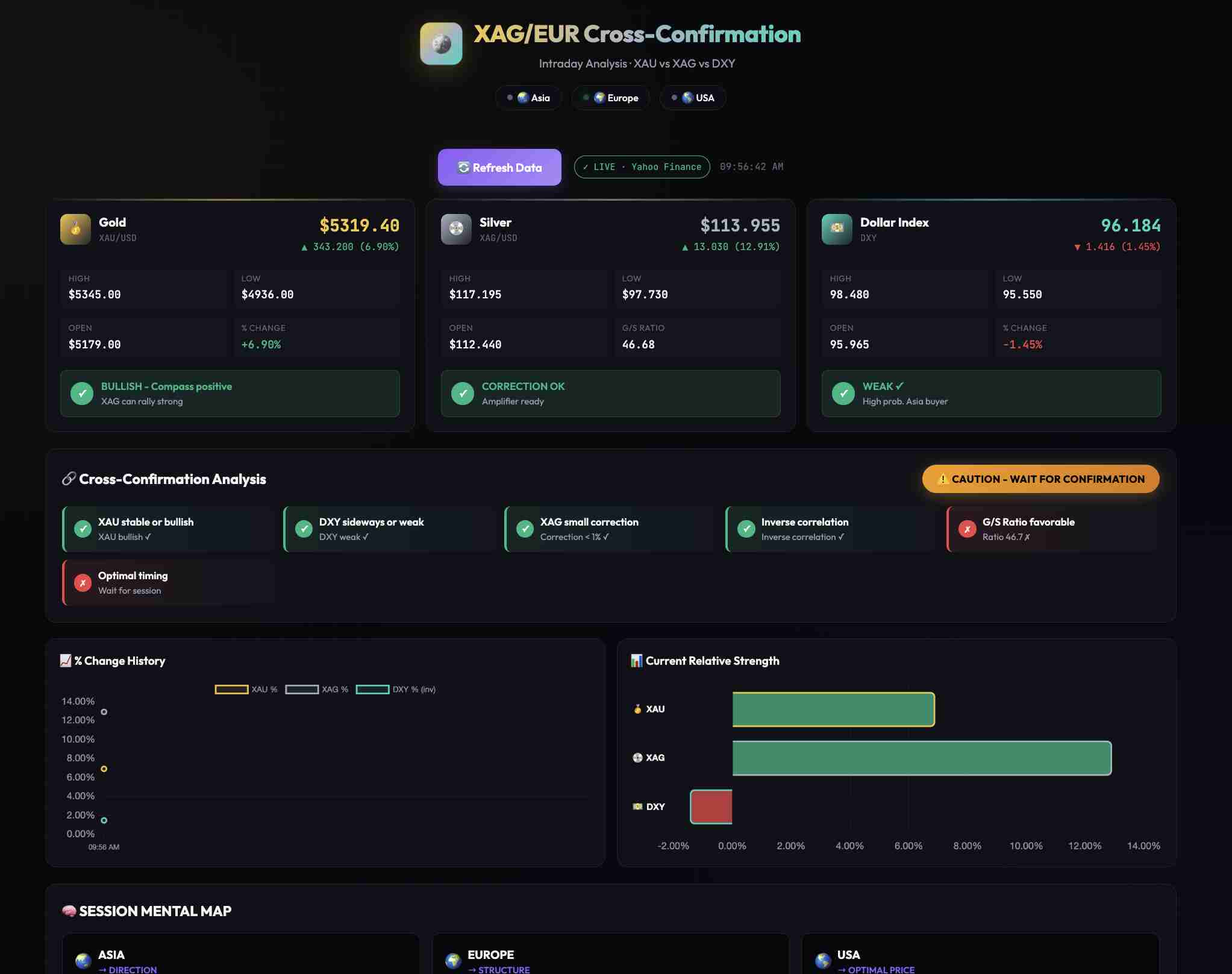
📊 Inter‑Session Flow Thesis: Silver (XAG) – Institutional Perspective

📊 Inter‑Session Flow Thesis: Silver (XAG) – Institutional Perspective

📊 Inter‑Session Flow Thesis: Silver (XAG) – Institutional Perspective

Executive Summary

This report outlines a flow‑based thesis explaining recurring intraday behavior in Silver (XAG), with particular focus on the interaction between Asian, European, and US sessions.
The objective is to distinguish between healthy corrections and true distribution, and to define timing, structure, and confirmation rules used by institutional desks rather than retail indicators.


1️⃣ Market Hierarchy: Who Does What?

The silver market is best understood as a distributed process, not a single‑session narrative.

Session Roles

  • Asia: Directional impulse

  • Europe: Structural maintenance

  • United States: Liquidity optimization & price discovery

The US session does not always define the trend direction; it often optimizes entry and exit prices for larger players.


2️⃣ Why the US Session Often Corrects

US session pullbacks are frequently misread as bearish signals. In most cases, they represent one or more of the following:

a) Profit Taking / Distribution of Asian Gains

  • Asia drives price expansion

  • Europe consolidates

  • US provides the liquidity needed to reduce exposure

This does not automatically imply bearish intent.

b) Intraday Risk Neutralization

US funds often:

  • Reduce overnight geopolitical and FX risk

  • Flatten exposure before Asian reopening

This behavior produces controlled pullbacks, not trend reversals.

c) Price Optimization

Corrections allow:

  • Re‑accumulation at better average prices

  • Preservation of a broader bullish structure

A strong trend requires corrections to remain sustainable.


3️⃣ Is the US Positioning Ahead of Asia?

Partially, but selectively.

  • Some US macro desks do position late‑session longs

  • Others simply exit and leave price discovery to Asia

  • There is no uniform behavior

The key insight:
👉 Asia does not rely on US positioning to buy.


4️⃣ Why Asia Buys Silver Consistently

Asian demand is structural, not tactical.

Key drivers:

  • Long‑term reserve diversification

  • Reduced reliance on USD‑centric assets

  • Preference for physical and quasi‑physical hedges

Silver acts as:

  • A high‑beta extension of gold

  • A macro hedge when gold is stable

Asia does not buy silver to defend fiat currencies daily, but as part of long‑term balance‑sheet strategy.


5️⃣ Technical Differentiation: Correction vs Distribution

Healthy Correction (Bullish Continuation)

  • Declining volume on pullbacks

  • Respect of H1 EMA 50 / 100

  • Retracements limited to 38–50%

  • Asia subsequently makes new highs

True Distribution (Trend Risk)

  • Expanding volume on down moves

  • H1 closes below EMA 100 / 200

  • Retracements exceed 61.8%

  • Asia fails to regain prior highs

📌 As long as H1 structure remains intact, the move is corrective.


6️⃣ Time‑Based Signals (US Session)

Key US time windows (CET approx.):

  • 15:30–16:30:
    Liquidity sweep / false breaks — observation only

  • 17:00–18:30:
    Decision zone

    • No continuation → correction likely complete

    • Expansion → deeper retracement risk

  • 20:00–21:30:
    Pre‑close behavior

    • Slow grind up → preparation for Asia

    • Aggressive sell‑off → distribution signal


7️⃣ Multi‑Asset Confirmation Framework

Gold (XAU)

  • Directional anchor

  • Silver does not lead without gold stability

Silver (XAG)

  • Volatility amplifier

  • Performs best when gold is stable or mildly bullish

Dollar Index (DXY)

  • Final arbiter

  • Weak or flat DXY → supportive for metals

  • Sustained DXY strength → risk of deeper correction


8️⃣ Timeframe Hierarchy (Critical)

  • H1: Early warning system

  • M15: Execution and precision

  • D1: Regime confirmation

Rule:

Never change macro bias without daily confirmation.
Never ignore an H1 warning from the US session.


Conclusion

This thesis reframes US session pullbacks not as weakness, but as structural optimization within a broader inter‑session process.
Understanding who acts, when, and why allows traders to align with institutional flows rather than react to surface‑level price action.


⚠️ Disclaimer

This report represents a market structure and flow interpretation, not investment advice.
All analysis is probabilistic in nature and must be validated against real‑time market conditions, risk parameters, and individual trading mandates.


Gratis
Trump Metals Report

Trump Metals Report

STRATEGIC MARKET ANALYSIS

Trump's Economic Policies & The Precious Metals

Paradigm Shift

A comprehensive thesis on geopolitical dynamics, tariff impacts, and trading strategies for Gold & Silver in the Trump 2.0 era

Publication Date: January 30, 2026

Focus Assets: XAU/USD, XAG/USD, XAG/EUR, DXY

Time Horizon: Q1-Q2 2026

Classification: For Professional Use Only

Gratis
📊

ETHER


📊 ETH/USD Strategic Entry Report

Macro‑Liquidity & Market Structure–Driven Approach monday 02 Feb.2026 


1. Market Context & Framework

Macro Environment

  • No systemic financial stress is visible in money markets or credit spreads.
  • High‑yield bonds remain resilient, suggesting risk appetite has not collapsed.
  • The current correction in risk assets is driven primarily by:
    • Temporary liquidity withdrawal
    • Positioning and derivatives unwinds
    • Extreme negative sentiment

This environment historically favors mean‑reversion trades and accumulation strategies, not panic selling.


2. Sentiment & Positioning Analysis

Key Observations

  • Crypto sentiment indicators are in extreme fear territory.
  • Rapid downside moves occurred during low‑liquidity windows, amplifying volatility.
  • The sell‑off is not characterized by capitulation, but by:
    • Stop‑loss cascades
    • Short‑term traders exiting leveraged positions

📌 Interpretation:
Extreme fear combined with non‑systemic stress increases the probability of a tactical rebound, even if the broader short‑term trend remains corrective.


3. Liquidity & Volatility Considerations

  • Liquidity-sensitive assets like ETH tend to underperform during:
    • Treasury cash absorption phases
    • Balance‑sheet tightening expectations

However:

  • Liquidity contractions of this type are cyclical, not permanent.
  • Structural monetary degradation (high debt, fiscal deficits) remains unresolved, supporting crypto assets over the medium to long term.

4. ETH/USD Technical‑Structural Setup (Non‑Price Specific)

Market Structure

  • Short‑term trend: Bearish / corrective
  • Medium‑term trend: Neutral to bullish
  • Long‑term trend: Bullish (structural)

ETH is currently transitioning from forced selling to price discovery near support, where professional participants typically scale in.


5. Entry Strategy (Risk‑Managed)

🎯 Strategy Type:

Staggered Accumulation with Tactical Upside Target


✅ Entry Conditions

Initiate ETH/USD exposure only if at least one of the following occurs:

  1. Momentum Exhaustion

    • Daily RSI stabilizes below 30 and begins to turn upward
    • Selling pressure decelerates (smaller red candles, long lower wicks)
  2. Volatility Compression

    • Sharp decline in intraday volatility after a sell‑off
    • Evidence of absorption near support (high volume, limited downside)
  3. Derivatives Reset

    • Funding rates normalize or turn mildly negative
    • Open interest declines while price stabilizes

📥 Entry Execution

  • Scale in using 2–4 tranches, not a single entry
  • Allocate:
    • 30–40 % on first confirmation
    • Remaining capital only after stabilization is confirmed

📌 This approach avoids mistiming the absolute bottom while maintaining favorable risk‑reward.


6. Risk Management

Stop‑Loss Framework

  • Use a soft invalidation level, not tight stops
  • Invalidation occurs only if:
    • ETH breaks below key support with expanding volume and rising volatility

Position Sizing

  • Risk no more than 1–1.5 % of total portfolio capital on the full position
  • ETH remains a liquidity‑sensitive asset, requiring disciplined sizing

7. Upside Objectives

Short‑Term (Tactical)

  • Mean reversion toward:
    • Prior breakdown zones
    • High‑volume nodes
    • 20–50 day moving average area

Medium‑Term

  • Upside continuation depends on:
    • Liquidity stabilization
    • Earnings resilience in risk assets
    • Absence of credit‑market stress

📌 ETH performance should be evaluated relative to liquidity conditions, not headlines.


8. Strategic Conclusion

  • The current ETH/USD decline is not signaling systemic failure, but a liquidity‑driven correction amplified by sentiment.
  • Extreme fear without structural stress historically favors selective accumulation, not liquidation.
  • ETH remains vulnerable short term, but attractive medium to long term under disciplined execution.

This is not a “buy the dip blindly” environment — it is a “buy rationally where fear is disproportional to fundamentals” environment.


⚠️ Disclaimer

This report is for educational and analytical purposes only and does not constitute financial advice. Crypto assets are volatile and require professional risk management.

Gratis